Several RootsTech presentations were recorded and are available for you to watch. It’s the next best thing to being there and you don’t need to pack a bag, stay in a motel room, spend money, or fight traffic.
Diggin’ Up Roots: RootsTech in general
I was so inspired by the RootsTech Conference last week and in the coming weeks I plan to share some of the tips and helps I found there. Next year’s RootsTech is February 3-6 in Salt Lake City and I highly recommend it. If you register, make sure you check the box for the “events,” as these were a lot of fun and were free. RootsTech is sponsored by FamilySearch and their partners. For beginners, intermediate, or advanced genealogists, it is wonderful!
Some of the highlights for me were former First Lady, Laura Bush and daughter, Jenna; Tan Le; and Donny Osmond. Besides being so educational, the whole weekend was great fun, mostly because my sister from Wisconsin attended with me.
RootsTech 2015
I’m off to Salt Lake City for RootsTech. Last year at the conference I learned how to “scrapbook” a family history and that got me started on my ongoing project, a children’s book about one of my great-grandfather’s brothers. I am excited to see what projects I will be inspired to undertake at this year’s RootsTech. But first things first – now that the long moving process is over and I am comfortable in my new surroundings, next week when I return home from the conference I will be back to blogging, more organizational tips, and my latest genealogy find which I am anxious to share.
New Digs: What Goes Around, Comes Around
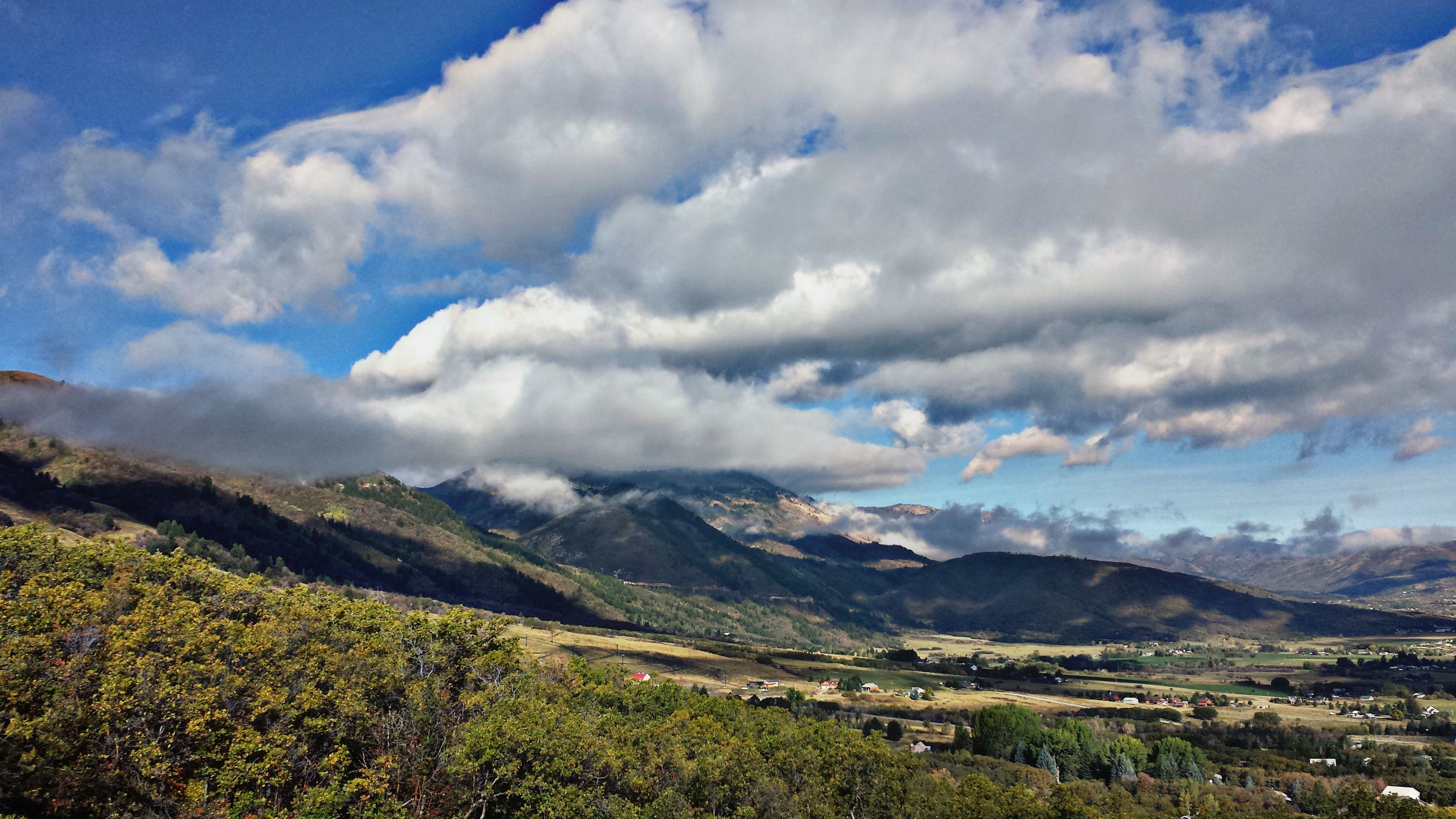
Two of my 3rd great-grandfathers, Clinton Doneral Bronson and Amos Betts Andrews, came to Utah with the Mormon pioneers in 1847. Clinton married Amos’s daughter, Lovisa Andrews, and both families settled for a time in Huntsville in the Ogden Valley. Clinton’s brother, Wilmer Wharton Bronson, also settled there with his family. Some of their daughters married into the Ferrin and Hammond families, and descendants still reside in the valley. The Ogden Valley is a beautiful, secret gem in the Wasatch Mountains. It is dominated by Pineview Reservoir, a popular boating and fishing lake, and three ski resorts (Snow Basin, Powder Mountain, and Nordic Valley). The valley is comprised of three towns: Huntsville, Eden, and Liberty.
When my husband and I began looking for a place to retire nearly five years ago, we ignored this beautiful valley, thinking it was too far away. But after two of our daughters ended up living a 40-minute drive from the valley, it became more of a possibility. In May we found a home we loved in Liberty, and here we are, living in the Nordic Valley area, just north of the very place where two of my grandfathers settled in the 1850’s.
I have researched the Bronson and Andrews families extensively, especially the Andrews family, and can’t help feeling like I have “come home.” Although the Amos Andrews family eventually left the valley, Amos was actually buried near Huntsville, but his grave was washed away. I feel even closer to him now and am excited to spend my time here doing even more research on his family. In my wildest dreams, I never expected this scenario to take place!
And during the move I came up with more ways to organize my stuff! Stay tuned!
Time for the reveal: what’s in that magic research notebook?
ORGANIZING & UTILIZING A GENEALOGY RESEARCH NOTEBOOK
(my favorite use of a 3-ring binder)
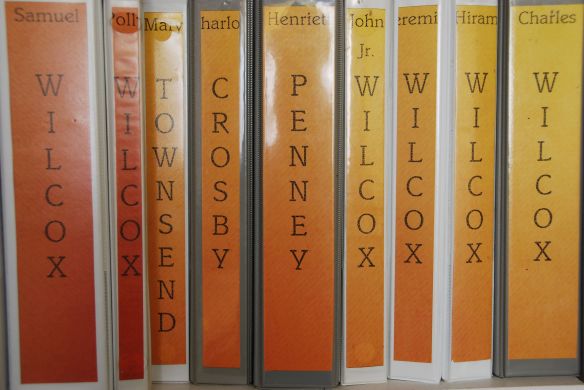
I learned about this research notebook from a LDS Family History Consultant, Jayare Roberts. In the 30+ years since I took his class, I have changed this method very little. When I finish research on a family, this essentially provides me with a family history complete with index, sources, and documents.
If you want to research exclusively from your computer and have no need for hard copies, this method is probably not for you. I like to work with hard copies as I research. I transfer the information to the computer when I am finished.
Here’s how it works:
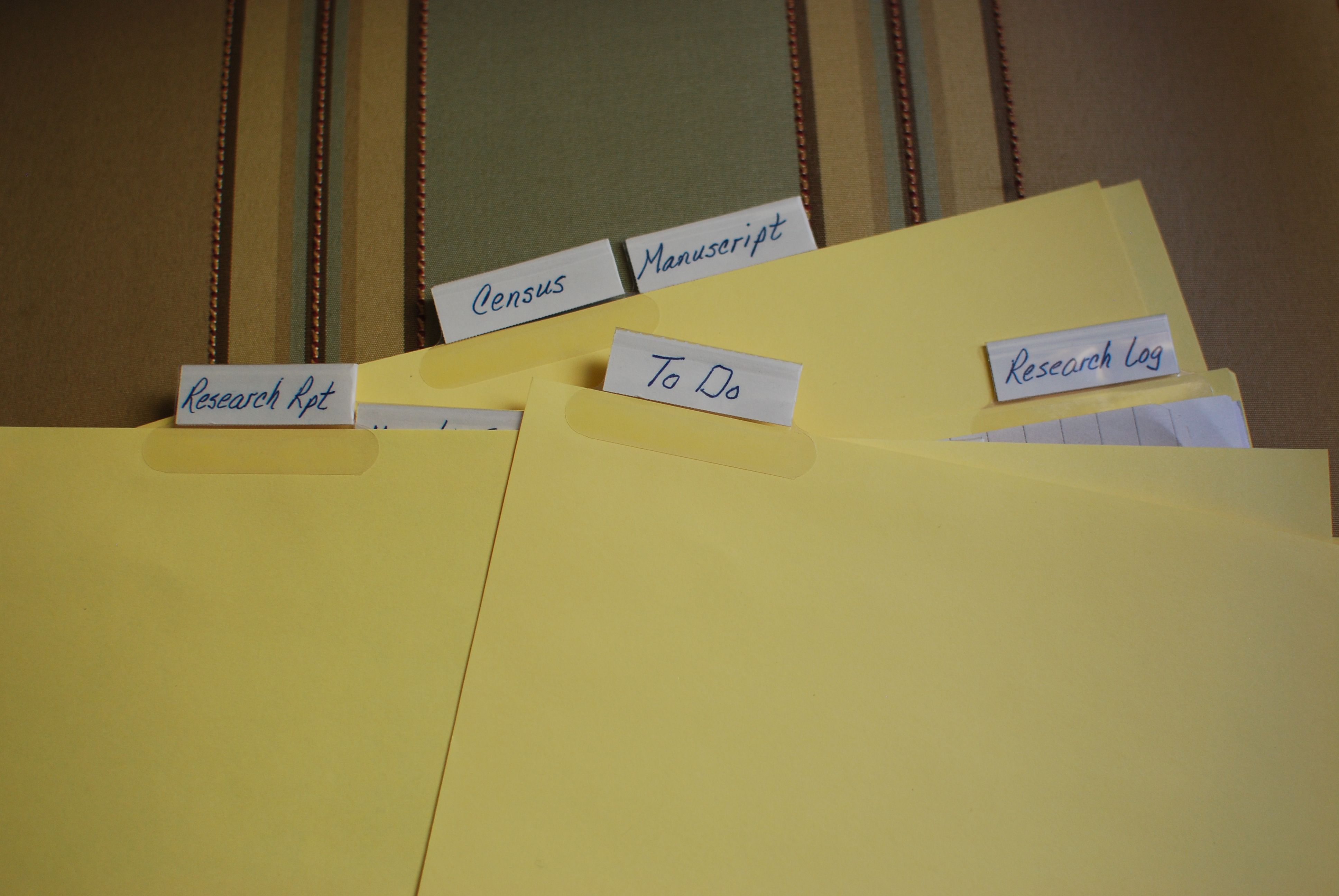
Use a 3-ring binder for each family. If the binder gets too big and you have accumulated a lot of info on the children, separate the children into their own binders. You may also end up with “in-law” binders. Separate the families out as much as needed, but for beginning research keep the family together. Buy a set of ten divider pages with plastic tabs for each notebook. (I often just make my own using old file folders. I can trim them to the size I want and make the divider tabs any size.)
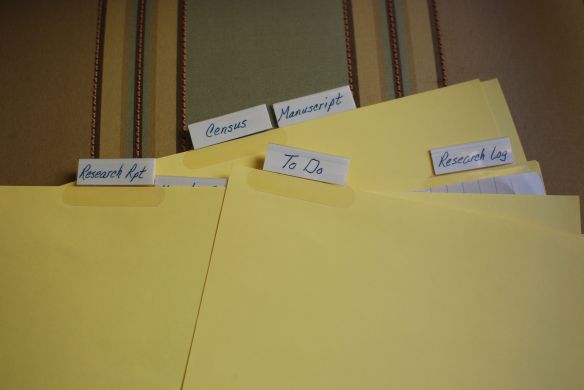
Set up the dividers and put them in the research notebook in this order:
- To Do List
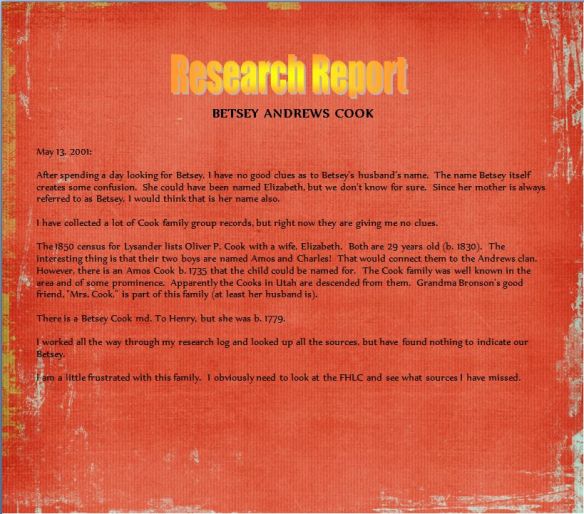
- Research Report
- Maps/Reference Material
- Correspondence
- Chronology/Narrative
- Pedigree Chart
- Family Group Record
- Census
- Research Log
- Manuscript
Here is a description of what goes behind each divider that creates the magic of your research notebook:
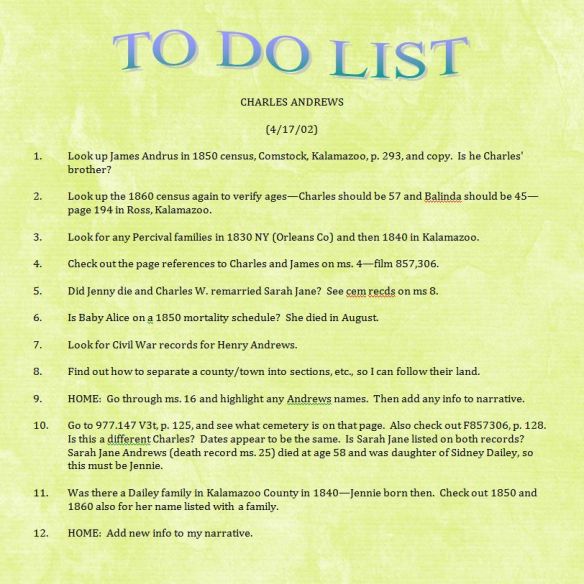
- As you think about records you should find or questions you have, jot them down on the To Do List. The next time you research, your To Do List is ready.
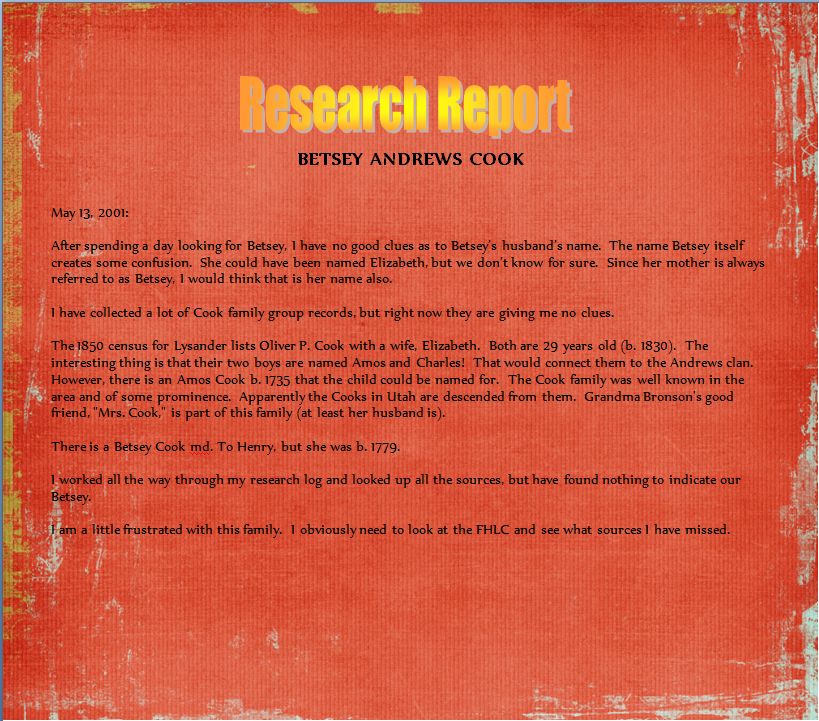
2. Every time you perform any research on the family, take a few minutes when you are finished to record what you did. Also record your thoughts, questions, feelings, everything that comes to mind about the family. It is so helpful when you pick up the book the next time, even if it is ten years later. It is also interesting to follow your research journey and becomes a research book of instructions for your posterity.
3. As you accumulate maps of the area or info about the towns and counties, put them in this section for future reference.
4. Correspondence includes letters, emails, posts on genealogy websites, anything that can be considered correspondence between you and another person. I keep these chronological by the person I am corresponding with. I also make sure addresses and phone numbers are recorded here for quick lookup.
5. A simple timeline of the family is a good way to start. As you find more information, the timeline may become more involved. Eventually you may want to turn this timeline into a narrative. I will give you an example of how to do this in a future post.
6. I like to keep a pedigree going both ways, ancestors and descendants, so I can see how this family fits into mine.
7. There are many family group record forms available on the internet. Pick one you like for research purposes. Or print out a blank family group record from your genealogy program. This is a place where you can quickly pencil in the information you find so you can see quickly what you have. Eventually you will want to transfer this information to the genealogy program on your computer.
8. I keep census records separate from the other research and I like them at the beginning of my research because I refer to them so often. I start with a census checklist. I will give you a couple of examples of these in a future post. I then include hard copies of all the census records in chronological order.
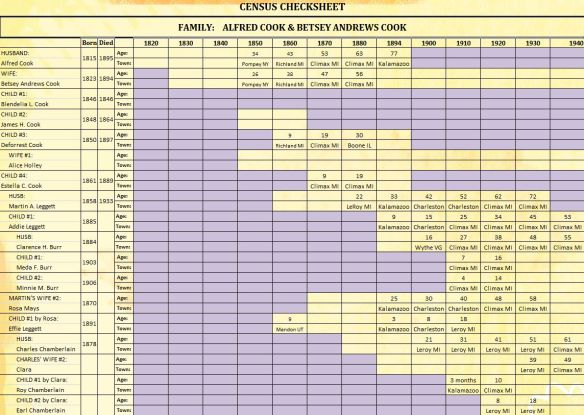
One of several census checksheets I have created over the years. I think I’m also addicted to spreadsheets.
9. The research log is the heart, or the magic, of this notebook. This is where you record every record you want to look at and every record you find. You can fill out a research log in advance if you are going to a research library by accessing their online catalog and recording the books and films that may have applicable documents. When you go to the library, your list of items is all ready and you don’t waste precious time accessing the catalog. (You should also use a research log for online research. However, I find this goes so quickly that I really have to discipline myself to write down every website I access.) The research log should contain the name of the record, the call number or film number, the date you looked for it, whether or not you found anything, and the document number you assigned to the records you found. These document numbers are assigned in order, no matter what the document is. If you found the death record first, it is #1. If you found the birth record next, it is #2. If you found a letter written to a cousin, it is #3. This is the beauty of the method – it is simple, quick, and then easy to find the document later. Make sure that you note “nothing” if the record you were looking at contained nothing on your family. This will ensure that you don’t look at the record again.
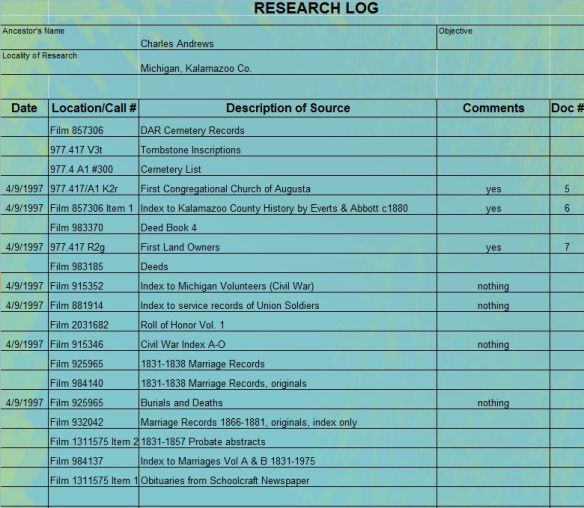
10. The manuscript section is where you put hard copies of the actual documents you find. If you find the death record first and have assigned it #1, write a “1” in the upper right hand corner of the document and put it behind “Manuscript.” When you find the second document, put a “2” in the upper right hand corner and file it in the notebook next. You can see that eventually you will have a notebook full of records with page numbers on them that will correspond to your index (research log). It is really a genius way of keeping everything accounted for.
By using this method, if your research is interrupted (and it will be), you can pick up your notebook again in six months and begin where you left off. Your research reports will jog your memory. Everything stays nice and neat and you can find any piece of info in seconds. Someone else can even take your notebook to the library and pick up where you left off. I think it’s MAGIC! If I have not made myself clear, please post your questions and I will explain in more detail.
Knick Knack Paddy Whack: give the girl a room
THIRD INSTALLMENT
STEP THREE: I really wanted to display photos and saw a great idea for doing this in the archive room. My husband made some wood frames for sheet metal so I could attach photos with magnets. We distressed the frames and painted them a flat brown. I was able to change out the photos frequently and give all the ancestors their moment on the wall of fame
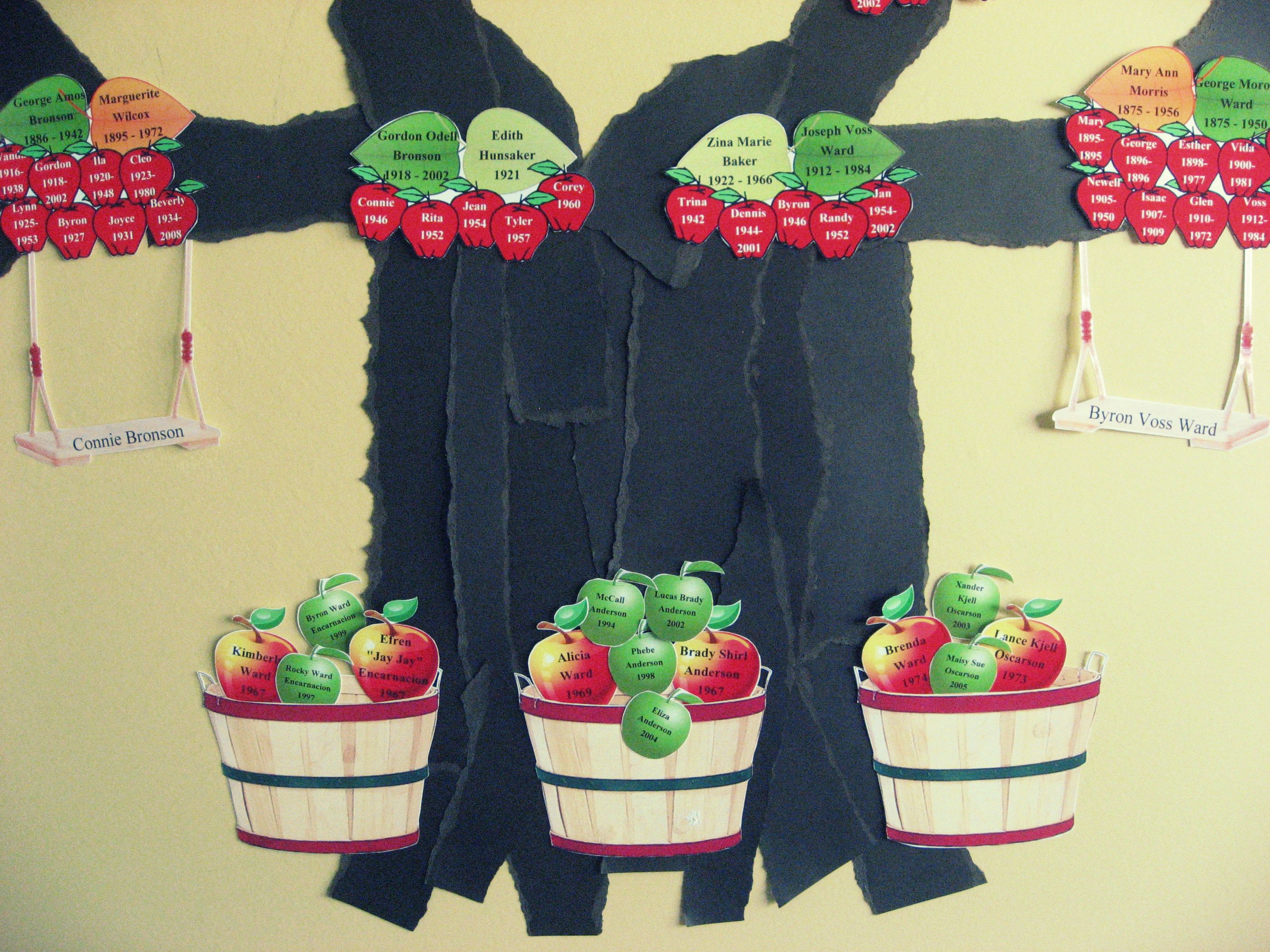
The finishing touch was the family tree I designed. It not only displayed my ancestors, but also my husband’s.
The three baskets were for each of our three daughters and their families. The swings indicated which side was for my ancestors and which side was my husband’s. I asked my daughter, Brenda, to paint the tree on the wall, but she had a better idea – torn paper!
I eventually transferred the tree to a piece of heavy, clear vinyl and held it on the wall with thumb tacks.
I loved this little archive room and my grandchildren spent lots of time there. But some items were missing — the trunk, my mother-in-law’s table, some vintage lamps, the tools, and other larger items. And I kept finding more heirlooms that I had forgotten about. What to do? My family knows I love change, in fact I thrive on it, so watch for my next post, the final (maybe) installment of Knick Knack Paddy Whack.
Knick Knack Paddy Whack: give the girl a room
SECOND INSTALLMENT
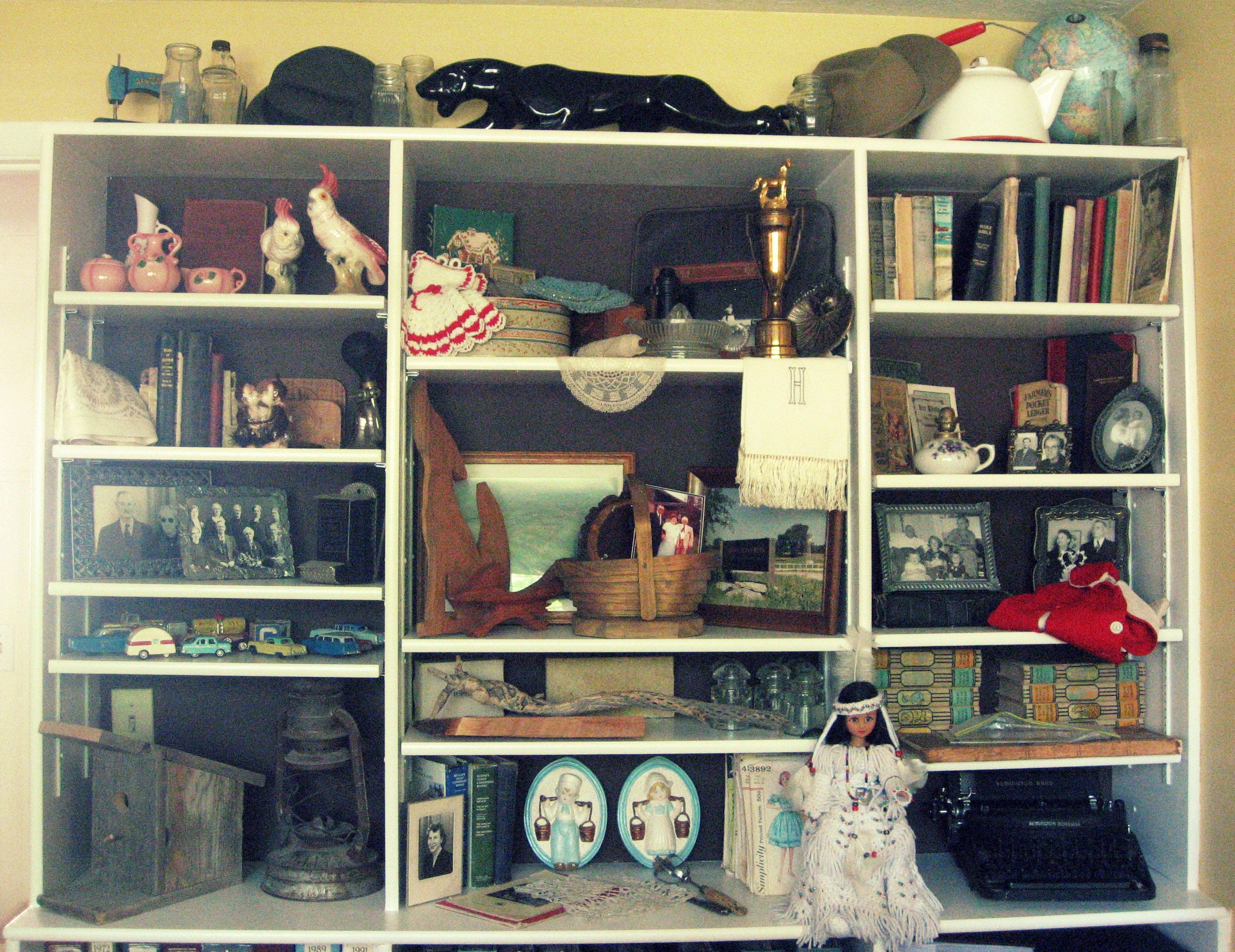
STEP TWO: So much stuff and so little space! Luckily the small room I had earmarked for the “archive room” already had a bookcase covering one wall, so I started there.
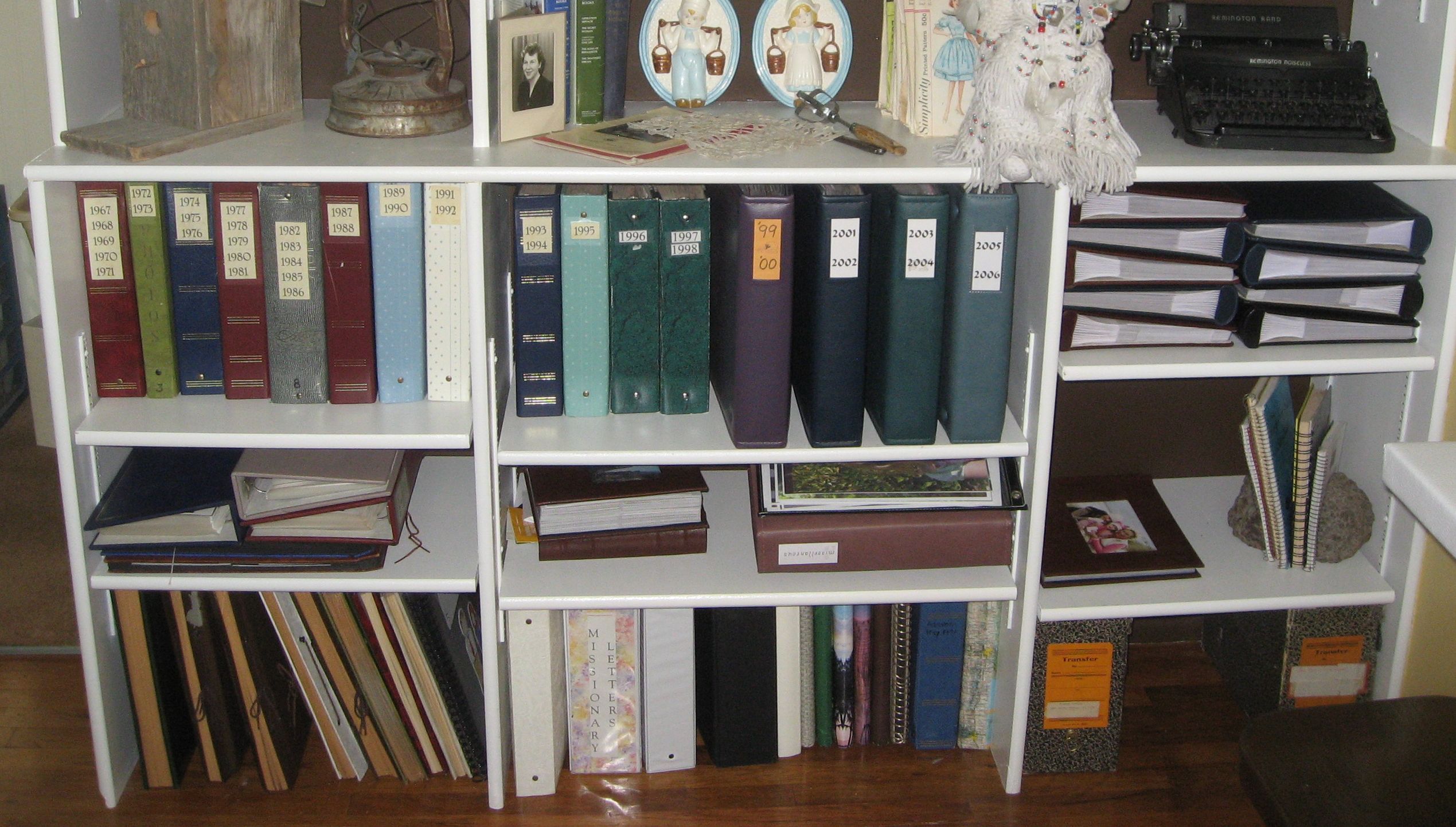
I began with a whole shelf dedicated to each person, but quickly ran out of room and had to double up. But I liked the effect. Now each ancestor’s memorabilia was on display, much of which had previously been in storage.
It seemed right for the scrapbooks and the genealogy to be in this room too, so the scrapbooks went on the bottom shelves under the heirlooms. The grandkids immediately began spending time in the room looking at scrapbooks on the floor, so my handy-dandy carpenter husband installed a long shelf on the adjoining wall and I covered it in white padded vinyl. The grandkids could put the large scrapbooks on the shelf and have plenty of room to maneuver them. We already had a wooden bench that fit perfectly under the shelf.
My 1966 Magnavox stereo console, which still worked like a charm, had been in my mom’s living room since the 70’s, so I reclaimed it and put it in the “archive room” with some vinyls from the 60’s. The grandkids promptly asked, “What are these???” It was fun showing them how a phonograph worked! There was also room for my mom’s 1940’s rocking chair and the rocking chair I received for Christmas when I was two.
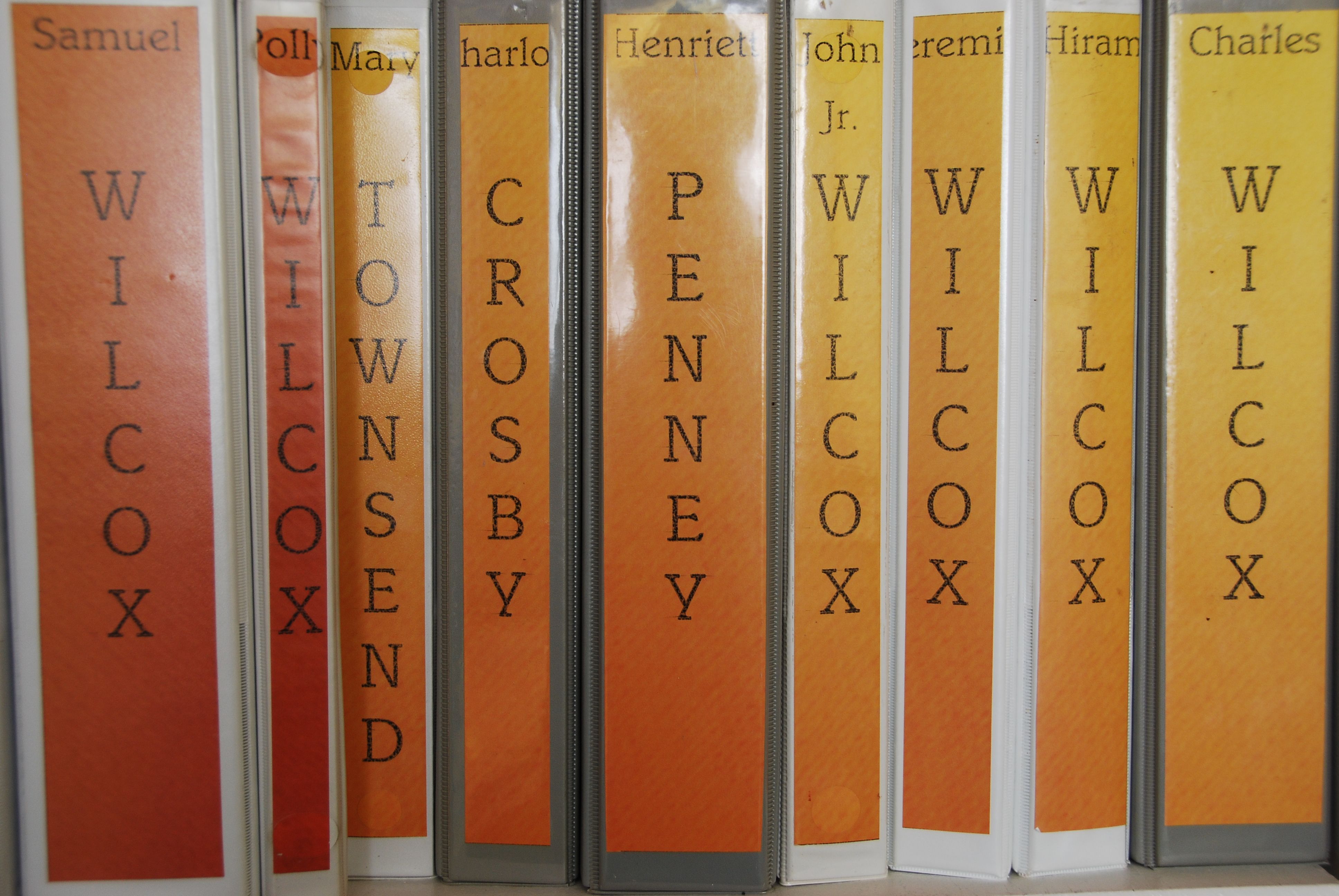
My husband had made a bookcase for another room, but it was perfect for the genealogy binders (you will recognize them from a previous post). An unfinished lace tablecloth started by my great-grandmother topped the bookcase with a wooden candle box and a lamp inherited from my mother-in-law’s fireplace mantel.
Watch for the THIRD INSTALLMENT of Knick Knack Paddy Whack to see my favorite finishing touches in the “archive room.”
Knick Knack Paddy Whack: give the girl a room
Every time I was asked to give a presentation on genealogy, I would go through my house and box up tons of items for display. I realized I really did have a lot of heirlooms and memorabilia and knick knacks from ancestors. But none of it was readily available or displayed for the family to see. I decided to do something about that. Although my home is quite small by today’s standards, I managed to turn the smallest room into an “archive room” or as my granddaughters called it, “the museum.” In order to do that, I had to kick the grandkids out of their cute playroom. I know, cruel Grandma, but it was time for them to move downstairs anyway where they would have more room for cartwheels and “Just Dance.”
STEP ONE: Gather up everything that belonged to an ancestor. By my definition, this was anyone older than my generation, dead or alive!
My collection ended up being everything from books to knick-knacks to collectibles to linens to tools to furniture. These were not things of great monetary value, but were items of irreplaceable family value. Each knick knack told a story. And I was amazed at how much stuff I had! I wasn’t sure that little room would hold it all, but I was determined.
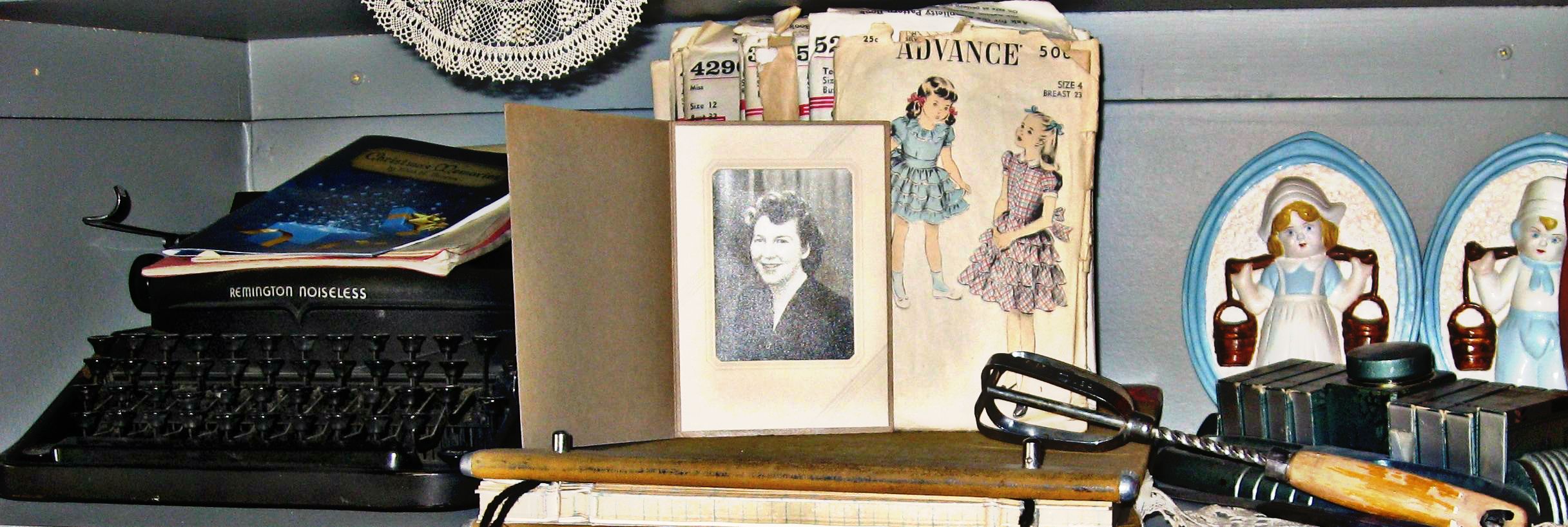
My mom’s first typewriter, eggbeater from the 40’s, patterns she used to make my clothes in the 40’s, the set of books she kept for my grandfather’s business, plaques that hung on our kitchen wall in the 50’s, Belgian lace she made later in her life.
My grandfather’s glasses, hat, rodeo shirt, Shetland pony trophies, buggy whip, business documents.
Precious items from my two grandmothers – crocheted pot holders, hats, bags, lemon juicer, recipe file, kerosene lamp, button box, bottle opener, bank book, ledger, book of fairy tales.
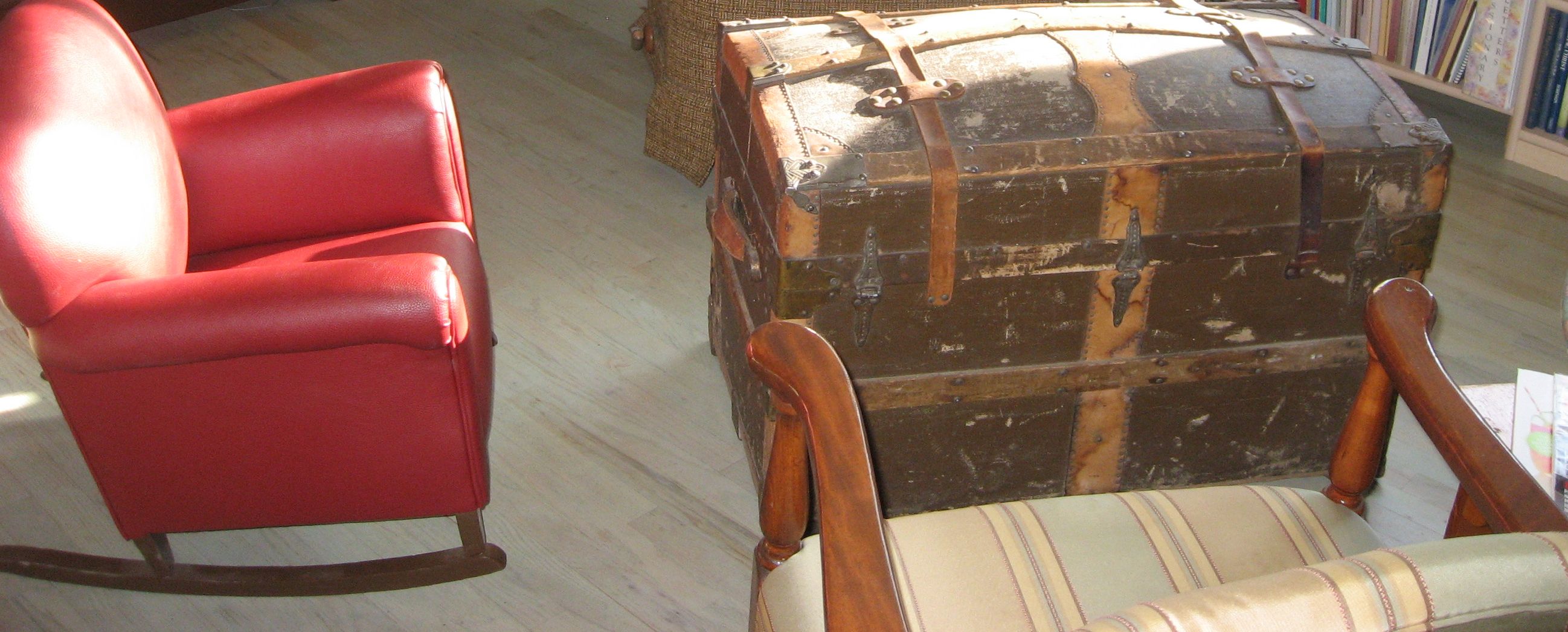
Mom’s first rocking chair and end table, great-grandfather’s trunk, my little red rocking chair (I’m not my own ancestor, but I couldn’t resist having it recovered for display).
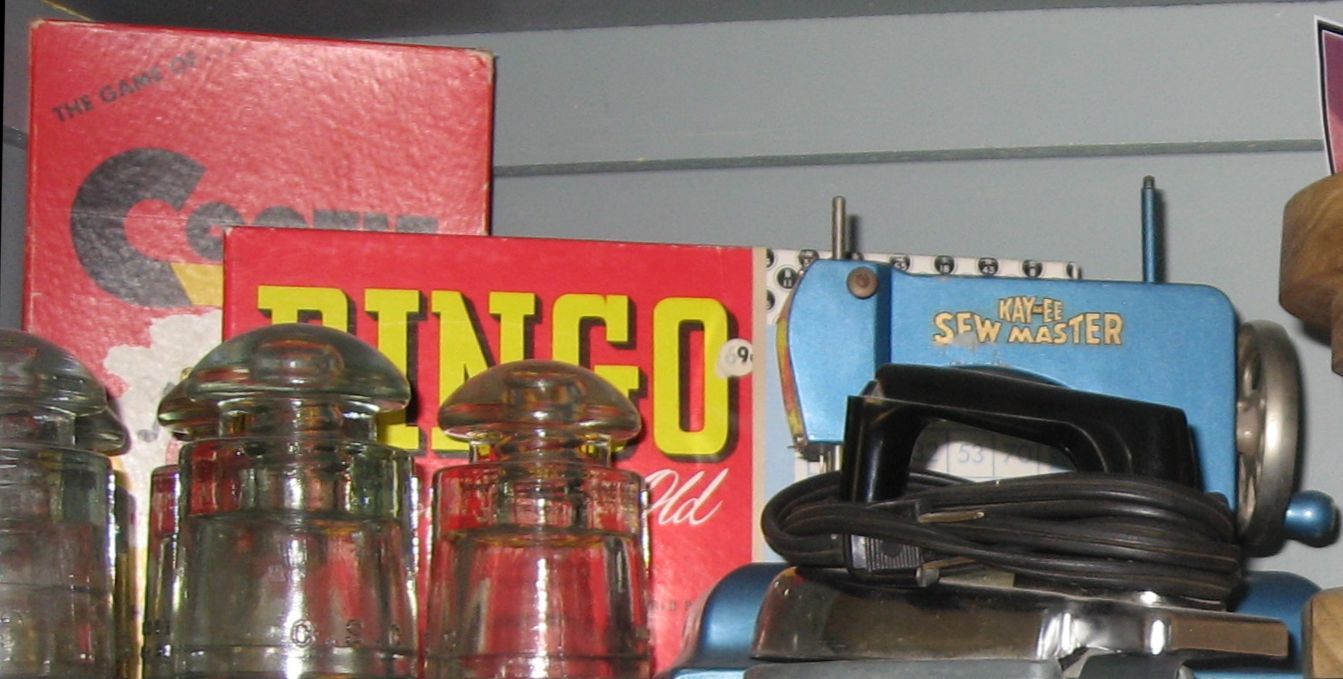
Original Bingo and Cootie games, child’s sewing machine and iron, vintage electric line insulators.
Everything from soup to nuts! I think you would be surprised at what you could find in your house that was handed down from grandparents. The next step was organizing all of the memorabilia and displaying it in my teeny tiny room. Watch for Installment 2 to see if I was able to do it!!!
Let It All Hang Out: find the courage to write that book
Try My Tricks: taking advantage of cousins and classes
The first “Genealogy Miracle” I posted contained some great genealogy lessons. They are tricks I have learned through the years and use frequently.
- Genealogy research trips are fabulous adventures and should be undertaken as often as possible, both for research and for nostalgic value. I have some great stories about research trips and new cousins that I will post in the future.

My daughter, Kimi, and I on a Michigan research adventure trip.
- Notice if a particular family seems to show up wherever your family lives. This is a good indication that they are more than friends!
- If the family moves to a nearby county, it may indicate that other relatives live there. It is a good place to look for the wife’s family.
- Another great trick is to stop and research a family that appears to have no connection, but keeps showing up on your family’s records.
- Take advantage of webinars and online classes. We can’t remember everything forever, so it is good to be nudged once in a while by a good class. There are fabulous webinars out there. Some of my favorites are those offered by Legacy Family Tree. And classes taught at seminars such as RootsTech are always good.
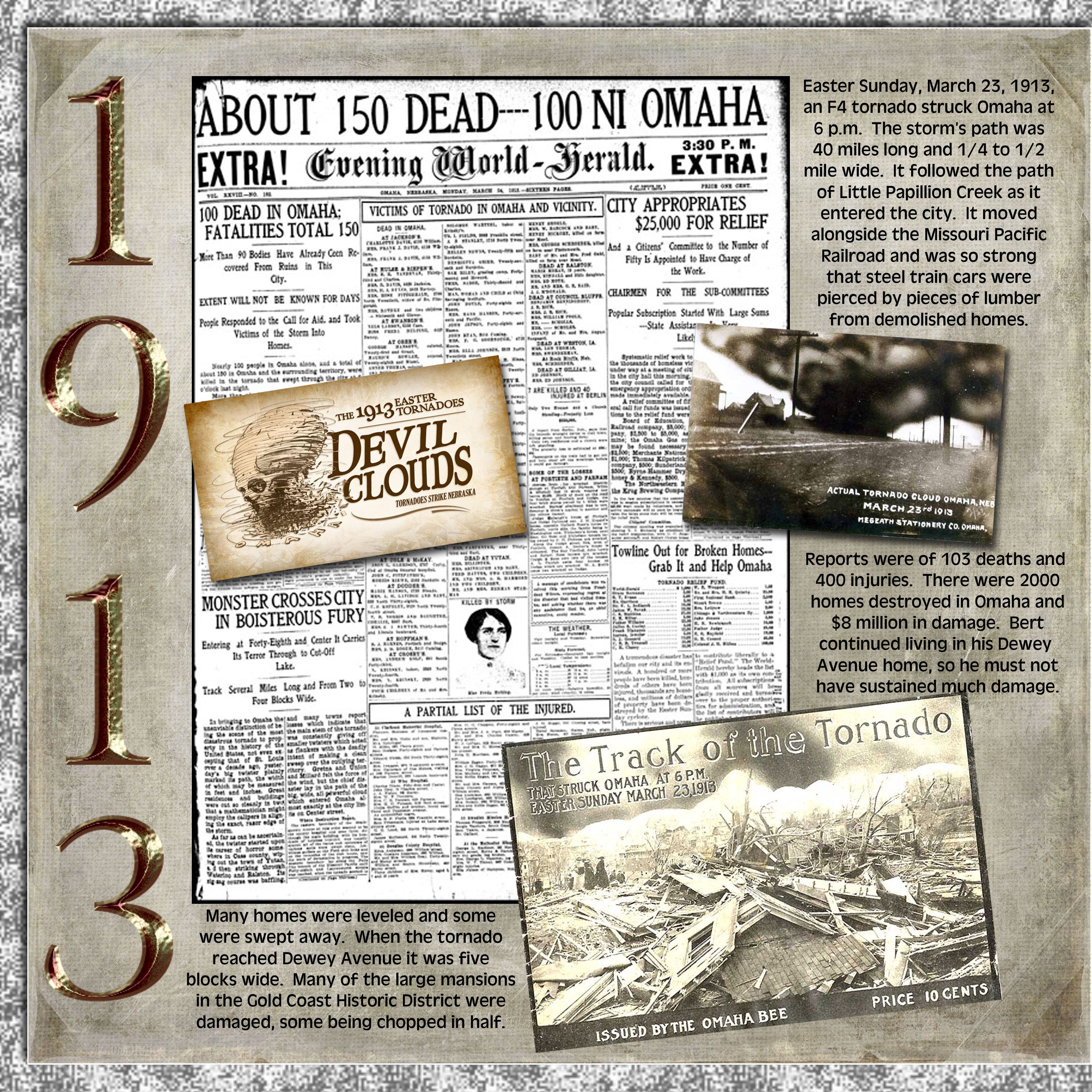
- Newspapers hold a wealth of information. I located an entire family in Omaha, Nebraska and found out everything I needed (and more) because the complete Omaha World-Herald is available at genealogybank.com. I have found dozens of events and dates in newspapers that I could find nowhere else and have been able to put whole families together just from newspaper clippings.
- Descendancy research is the gem! This is one of the best tricks of research. Not only do I meet wonderful cousins that I didn’t know existed, but they are usually able to fill in the gaps and give me important information. And as years pass, the older existing descendants get fewer and fewer, so don’t hesitate! Phone calls are great, but meeting these cousins is an extra bonus. Sitting with them in their living room jogs their memories and brings out the old photos and stories.
- Be persistent, patient, and thorough. Someone once said that if a document survives, you can find it. Go with your gut feeling.
- It’s good to have research helpers – someone to take photos, someone to help sort through papers, and someone to bounce your ideas off and to give you encouragement.